If Jesus Can Feed 5,000 PNG
A Designer’s First Glance: Warmth, Simplicity, and Quiet Confidence
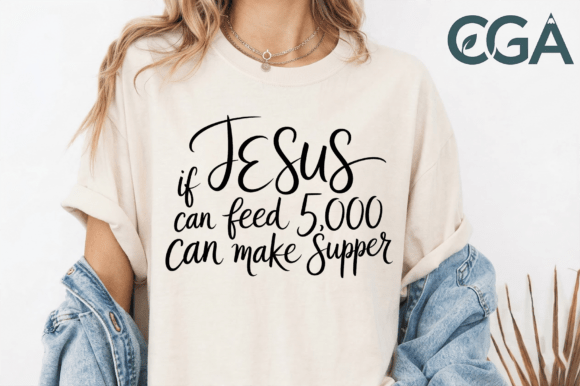
When If Jesus Can Feed 5,000 PNG landed in my inbox, I didn’t open it expecting fireworks — and that’s exactly why it held my attention. It’s a T-Shirt Designs-style layout: clean, centered, softly rounded lettering with subtle script flourishes on “Jesus” and “5,000.” No halos, no loaves or fishes illustrated — just the phrase, grounded and reverent without being stiff. The visual personality leans toward gentle sincerity, not sermonizing. That makes it unusually versatile: think embroidered baby onesies for a baptism gift, minimalist sweatshirt fronts for church volunteers, or linen tea towel monograms for a faith-based boutique.
Real Project Test: Stitching It onto a Linen-Cotton Kitchen Towel
Last week, I prepped If Jesus Can Feed 5,000 PNG for a client’s small-batch kitchen towel line — natural fiber, medium weight, slightly textured. I converted the PNG to a machine embroidery design using vector tracing (no auto-digitizing), then manually adjusted stitch density to avoid puckering. What stood out immediately was how well the letterforms held up at 3.75" wide: the curves stayed smooth, the spacing between “Can” and “Feed” allowed breathing room for satin stitch definition, and the numerals “5,000” retained legibility without needing outline reinforcement. Customers noticed — not because it shouted, but because it felt intentional, unhurried, and handmade in the best sense.
Where It Shines — And Where It Asks for Thoughtful Handling
If Jesus Can Feed 5,000 PNG excels on stable, medium-to-heavy fabrics: cotton twill aprons, fleece-lined sweatshirts, structured tote bags, and woven pillow covers. Its moderate height-to-width ratio means it scales cleanly from 3" to 5" without distortion — ideal for both standard hoop sizes and commercial embroidery frames. On baby embroidery projects like gauzy swaddles or organic cotton bodysuits, I recommend pairing it with lightweight cutaway stabilizer and reducing fill stitch density by 15% to preserve drape.
Proceed with care on stretchy knits (think lightweight t-shirts or raglan sleeves) — the letter spacing is generous, but tight curves in “Jesus” can distort if hooping tension isn’t even. Dark fabric? Yes — but test thread colors first. A deep navy works beautifully with ecru or oatmeal thread; black thread risks flattening the warmth of the phrase. Avoid placing it directly over seams or curved surfaces like cap crowns unless you’re confident in your hooping technique and backing support.
What It Adds to Your Finished Product — Beyond the Thread
- Visual appeal: It reads clearly at arm’s length but rewards closer looking — the slight taper on “Feed,” the soft terminal on “000.” Not flashy, but memorable.
- Stitching clarity: No overlapping outlines or micro-details that vanish under dense fill. Every character translates cleanly into satin and running stitch.
- Product value: Elevates simple items — a plain canvas tote becomes a meaningful keepsake; a basic crewneck gains quiet distinction.
- Customer trust: Buyers recognize craftsmanship when letterforms don’t wobble or crowd. This design signals care, not automation.
- Giftability: Especially strong for milestone gifts — baby dedications, graduation blessings, or pastoral appreciation tokens.
Practical Notes Every Embroidery Designer Should Run Through
Before stitching If Jesus Can Feed 5,000 PNG into your next project, do these five things:
- Test on scrap fabric matching your final product’s weight and stretch — especially if using textured weaves or blends.
- Check thread color contrast on both light and dark mockups; what reads well digitally may mute on fabric.
- Review stitch density in the numerals and inner curves — high density can cause stiffness in baby embroidery or holiday embroidery on delicate fabrics.
- Confirm hoop size compatibility: this design fits comfortably in a 4"x4" hoop at 3.5", but pushing beyond 5" may require re-digitizing for stability.
- Verify licensing terms before listing as part of an Etsy seller bundle or small shop product — some digital embroidery files restrict commercial redistribution or require attribution.
Fitting Into Your Creative Workflow — Not Just Your Hoop
This isn’t a “throw-it-on-and-go” embroidery file. If Jesus Can Feed 5,000 PNG invites intentionality — which is its strength. It pairs naturally with neutral palettes, natural fibers, and thoughtful branding. For craft business owners building a cohesive line, it anchors collections around themes of provision, gratitude, and quiet faith — think embroidered tea towels paired with printable mockups of scripture-inspired kitchen prints, or sweatshirt embroidery coordinated with hand-stamped gift tags.
Hobbyists and makers will appreciate how little it demands in corrections: no jagged edges to smooth, no tiny serifs to lose in fill stitch, no fragile elements that snag during trimming. And for Etsy sellers curating digital embroidery files or physical embroidered patches, this design stands out precisely because it doesn’t try too hard — it serves the message, not the machine.
Final Thought: A Design That Breathes With Its Purpose
Some embroidery files feel like they were built for speed. If Jesus Can Feed 5,000 PNG feels built for resonance. It doesn’t rush the eye or overwhelm the fabric. Whether stitched onto a child’s bib, a pastor’s apron, or a limited-run boutique tote bag, it lands with calm assurance — not because it’s loud, but because it’s clear, balanced, and respectfully scaled. In a market crowded with busy fonts and over-digitized motifs, that kind of restraint is rare. And for designers who know that every stitch carries weight, that’s not just practical — it’s professional.